
Building a home is exciting, but it can also be stressful.
For the homeowner, there is a lot of waiting, wondering, and trying to understand what is happening behind the scenes. For the builder, there are crews to manage, schedules to coordinate, inspections to pass, materials to track, and constant questions to answer.
One of the simplest ways to reduce confusion during a construction project is to communicate clearly at key milestones.
Milestone updates help homeowners know what has been completed, what stage the project is in, and what comes next. For builders, these updates create a more consistent communication rhythm, reduce repeated questions, and help document the progress of the project from start to finish.
What Is a Milestone Update?
A milestone update is a simple project communication sent at an important stage of construction.
It does not need to be complicated. A good milestone update usually explains:
- What was recently completed
- What phase the project is in now
- What happens next
- Whether any decisions are needed
- Why the current stage matters
- What the homeowner should expect
For example, a builder might send a milestone update after important stages such as foundation work, framing, rough-in mechanicals, insulation, drywall, finishes, punch list, or before the final walkthrough.
These updates help turn a complex building process into something the homeowner can follow.
Why Homeowners Need Milestone Updates
Most homeowners do not fully understand the construction process.
They may see progress from the outside, but they often do not know what that progress means. A quiet jobsite might look like nothing is happening. A messy stage of the build might feel concerning. A delay might seem like neglect when it is actually caused by an inspection, weather, materials, or a necessary construction sequence.
Milestone updates help fill that communication gap.
When homeowners receive clear updates, they are less likely to feel ignored or uncertain. They can see that the project is moving forward, even when the progress is not obvious from the street.
A simple update can help answer questions like:
“What was done this week?”
“Why does this stage matter?”
“What are we waiting on?”
“What comes next?”
“Do I need to make a decision?”
That clarity builds trust.
Why Builders Benefit From Milestone Updates
Good communication is not only for the homeowner. It also helps the builder.
Without a clear communication rhythm, homeowners may call, text, or email whenever they feel unsure. That can create interruptions for project managers, superintendents, office staff, and business owners.
Milestone updates help builders get ahead of questions before they become repeated conversations.
Instead of answering the same question multiple times, the builder can provide a clear update at the right point in the project. This makes communication feel proactive rather than reactive.
Milestone updates can also help protect the builder’s reputation. Homeowners may not remember every detail of the construction process, but they will remember how they felt during the project. If they felt informed, respected, and included, the experience is usually better.
Silence Creates Stress
One of the biggest problems in construction communication is silence.
The builder may be doing excellent work. The crews may be on schedule. The project may be progressing exactly as expected.
But if the homeowner does not know what is happening, silence can create doubt.
They may begin to wonder whether the project is delayed. They may worry that something was missed. They may assume no one is paying attention.
In many cases, the problem is not the work itself. The problem is that the work was not communicated.
Milestone updates help prevent that.
They give homeowners confidence that progress is happening and that the builder is paying attention.
Milestone Updates Create a Better Project Record
Milestone updates are not just communication pieces. They also create a useful project record.
When updates include photos, notes, dates, and descriptions, they become a timeline of the build. This can be helpful if questions come up later about what was completed, when it was completed, or what was visible before being covered.
This is especially useful during stages like:
- Foundation
- Underground utilities
- Framing
- Electrical rough-in
- Plumbing rough-in
- HVAC rough-in
- Insulation
- Pre-drywall
- Drywall
- Final finishes
- Punch list
- Pre-close walkthrough
Many important parts of a home are covered up as the project moves forward. Once drywall is installed, certain details are no longer visible. A documented milestone update helps preserve those details.
Photos Make Updates More Valuable
A written update is helpful, but photos make it stronger.
Homeowners do not always know construction terminology. A photo can show progress in a way that is easier to understand than a long explanation.
Photos can show:
- Framing progress
- Room layouts
- Mechanical rough-ins
- Electrical panel locations
- Plumbing locations
- Insulation installation
- Drywall progress
- Exterior finishes
- Completed details
- Items being corrected
When photos are organized by milestone, they become much easier to reference later. Instead of digging through random jobsite photos, the builder and homeowner can look back at a specific stage of the project.
Milestone Updates Reduce Repeated Questions
Builders often deal with repeated homeowner questions because the homeowner does not know where the project stands.
Questions like these are common:
“When will drywall start?”
“Has the inspection happened yet?”
“What is next after framing?”
“Why does it look like nothing changed this week?”
“Can we see what is behind the walls?”
A milestone update can answer many of these questions before they are asked.
That does not mean homeowners will never have questions. But it does help reduce unnecessary back-and-forth and gives the builder a clear communication system.
Milestone Updates Help Set Expectations
Construction is full of stages that may not make sense to a homeowner.
Some phases move quickly. Others feel slow. Some days involve visible progress. Other days involve coordination, inspections, corrections, drying time, or waiting for the next trade.
Milestone updates help set expectations for each stage.
For example, after framing, the homeowner may expect drywall to begin soon. But the builder knows that electrical, plumbing, HVAC, inspections, and insulation may need to happen first.
A milestone update can explain this clearly:
“Framing is complete. The next stage is rough-in work, where the major mechanical systems are installed before the walls are closed.”
That kind of explanation helps homeowners understand the sequence and reduces frustration.
Better Communication Can Lead to Better Referrals
A homeowner’s experience is not based only on the finished home.
It is also based on the process.
Did they feel informed?
Did they understand what was happening?
Did they feel like the builder was organized?
Did they feel confident during the project?
Milestone updates help create a better experience. A homeowner who feels informed during the build is more likely to speak positively about the builder afterward.
Good communication can become part of the builder’s reputation.
Builders Do Not Need to Overcomplicate It
Milestone updates do not need to be long or polished.
In fact, simple is often better.
A good milestone update can be built around a basic structure:
What happened: A short summary of completed work.
Where we are now: The current phase of the project.
What comes next: The next expected step.
What you need to know: Any decisions, delays, inspections, or expectations.
Photos: A few organized images showing the milestone.
That is enough to make the homeowner feel informed without creating a heavy administrative burden for the builder.
The Goal Is Clarity
Construction projects have a lot of moving parts. Homeowners do not need to know every detail, but they do need to know enough to feel confident.
Milestone updates create that clarity.
They help homeowners understand the process, reduce uncertainty, and see the progress being made. They help builders communicate consistently, document important stages, and build trust throughout the project.
In the end, a milestone update is more than a progress note.
It is a way to say:
“We are paying attention. Your project is moving forward. Here is what you need to know.”
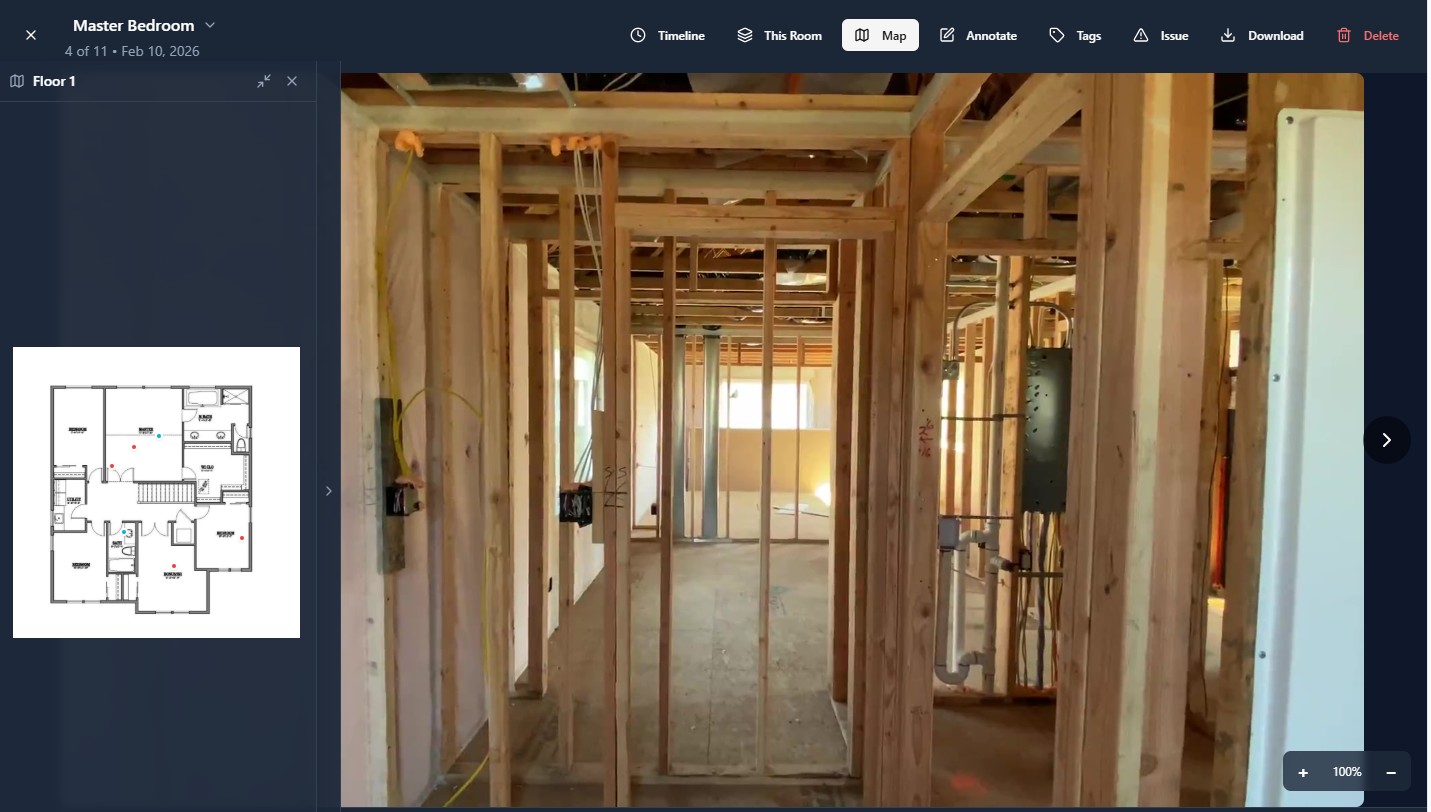
What Could Have Prevented the Doorless Room?
Looking back at that jobsite, the solution was not complicated.
A documented site walk could have helped.
Photos tied to the floor plan could have made the missing opening obvious.
A pre-drywall checklist could have raised the issue before the wall was closed.
A simple defect log could have kept the problem visible until it was fixed.
Proof of verification could have shown what was reviewed and when.
That is the kind of process ACTABUILD is designed to support.
Not more paperwork for the sake of paperwork.
Just a cleaner way to capture the right photos, connect them to the right location, and keep project information organized before small issues become bigger ones.
Building with a Better Record
Construction moves quickly. Once work is covered, buried, painted, or finished, it becomes harder to verify what happened.
ACTABUILD helps builders slow down the chaos just enough to create a useful record.
A record of progress.
A record of conditions.
A record of decisions.
A record of issues that need attention.
A record of work that may never be visible again.
That is why ACTABUILD exists.
Because no builder wants to discover the construction version of a room without a door after it is too late.
And because better documentation gives everyone on the project a better chance to build with clarity.